-
Interactive DashboardsCreate interactive BI dashboards with dynamic visuals.
-
End-User BI ReportsCreate and deploy enterprise BI reports for use in any vertical.
-
Spreadsheet AnalyticsNewLast-Mile Analytics Tool.
-
Narrative Data StoriesThe Next Evolution of Data Storytelling
-
Automated Business DocumentsNewDocument Generation for Smarter Workflows
-
Visual Data Pipeline BuilderDesign Complex Data Flows, Simply.
-
Wyn ArchitectureA lightweight server offers flexible deployment.
-
 Wyn Enterprise 7.1 is ReleasedThis release emphasizes Wyn document embedding and enhanced analytical express...
 -
 Choosing an Embedded BI Solution for SaaS ProvidersAdding BI features to your applications will improve your products, better serve your customers, and more. But where to start? In this guide, we discuss the many options.
-
Visual GalleryInteractive sample dashboards and reports.
-
BlogExplore Wyn, BI trends, and more.
-
WebinarsDiscover live and on-demand webinars.
-
Customer SuccessVisualize operational efficiency and streamline manufacturing processes.
-
Knowledge BaseGet quick answers with articles and guides.
-
VideosVideo tutorials, trends and best practices.
-
WhitepapersDetailed reports on the latest trends in BI.
-
 Choosing an Embedded BI Solution for SaaS ProvidersAdding BI features to your applications will impr...
 -

Embedded business intelligence is the integration of business intelligence solutions within business process software. Embedded business analytics and embedded BI software provide software with capabilities such as data visualization, analytics, dashboards, and reporting. Instead of using a standalone application, embedded business intelligence enables business intelligence directly within an organization’s applications.
Embedded BI also leverages the data context from the business applications to provide relevant information to the users as they work in familiar environments. Placing BI capabilities and embedded data analytics into a single application results in greater productivity and a higher rate of user adoption than using multiple applications at the same time. Many organizations compare embedded bi tools with other analytics solutions to identify the best fit for long-term scalability.
The traditional BI approach depends on BI and IT teams to aggregate, analyze, and visualize the business data and provide the needed KPIs, charts, and other visualizations to help business decisions. Since this process involves multiple teams, it takes longer to produce an output that the business users can use for strategic and tactical decisions. Modern enterprise business intelligence and embedded BI solutions address this gap.
Traditional BI benefits from the in-depth analytics available to specialist teams. Embedded BI software makes advanced analytics more accessible by integrating real-time reports and interactive dashboards directly into applications that users use every day.
What is Self-Service BI?
Self-service BI tools allow users to analyze business data and present the results of that analysis without waiting for the organization’s IT staff members. It helps optimize decision-making capabilities across that organization by reducing the time to get to the analysis. Meeting embedded BI requirements is essential for maximizing value from embedded BI solutions.
Embedded BI integrates self-service BI tools into business applications to enhance user experience with techniques such as ad-hoc reporting, interactive dashboards, and data visualization.
Embedded BI, along with self-service BI capabilities, allows users to customize their business applications further to suit their unique needs and drive tactical and strategic decisions for growth. These customizations are now powered by embedded business analytics and data-driven functionality.
The embedded BI approach makes the BI reports and dashboards available to the users as part of the business application they use the most. Since they are part of the application, the application workflows determine the usage. The application behavior is seamless with the other business operations you would be doing as you use the application. This flexibility is one of the top embedded BI requirements for business success.
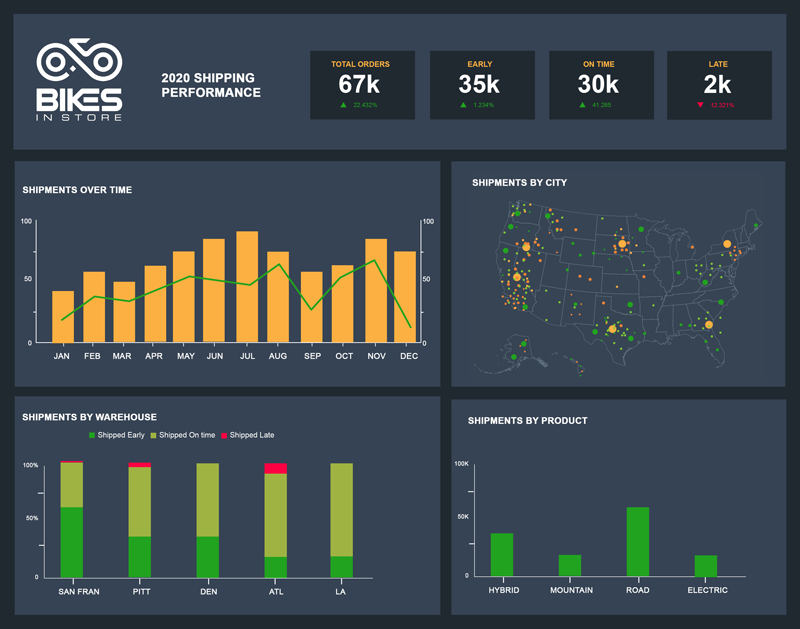
Embedded Business Intelligence Dashboard B – Shipping KPIs
Benefits of an Embedded BI
There are many benefits to embedding BI. Integrating BI into existing applications allows organizations to integrate embedded data analytics, visualization, and insights within their applications more effectively. Embedded business intelligence software in general also improves insights and metric reporting as it can work with multiple data sources.
With the KPIs and other actionable insights available directly in the business applications, managers can make quicker and better strategic decisions with help from embedded business analytics.
Effective Data Insights
Typically, businesses use customer relationship management (CRM) or enterprise resource planning (ERP) solutions to make decisions without relying on outside specialists.
The use of embedded embedded BI solutions and embedded data analytics are permanently changing how they make these decisions by eliminating the need to leave their current systems. Incorporating BI into existing applications allows users to make more accurate decisions to achieve the desired outcome. It also improves the users’ engagement in the system, which increases the value of these applications to the organization.
Improved Business Performance
Embedded BI can significantly enhance an organization’s business performance by integrating operations with analytics. This capability allows application users to analyze data and take immediate action on their results. Furthermore, embedded business intelligence software facilitates the improvement of business operations by enabling real-time analysis-based KPIs.
For example, a manufacturing organization could use analytics to monitor and prevent maintenance problems by identifying patterns in equipment breakdown.
Placing BI into applications allows users to make better decisions by combining insights into data with corrective action. It enables applications to leverage analytics as part of their standard workflow, rather than a separate process. Assume for this example that a POS has embedded analytics for making recommendations to customers. These analytics can run in the background and provide customers with coupons or suggest other products based on what they’ve already purchased. This is the real-world power of embedded BI software.
Buy vs. Build?
Today’s organizations are increasingly likely to capitalize on the trend towards integrating BI into their existing software. The journey towards this goal often begins by making the decision to build BI in-house or buying a third-party solution. Many companies find value in top-tier embedded BI solutions that meet enterprise embedded BI requirements.
It may be surprising to learn that an organization with software development as a core competency is more likely to obtain embedded BI from a third party than an organization that doesn’t develop software.
Independent software vendors (ISVs) specialize in developing software like CRM, ERP, and financial applications. However, these organizations recognize that BI analytics is typically outside their expertise. ISVs are, therefore, more likely than general enterprises to buy embedded analytics functionality from a third party.
Typical enterprises that don’t develop commercial software products are more likely to build this functionality themselves. They have proprietary business applications that IT teams have already developed, including those intended for consumption by outside parties such as customers and suppliers. These organizations are often eager to immediately begin an in-house build of analytics functionality upon deciding they need embedded BI.
However, general enterprises should first consider the embedded BI solutions and embedded data analytics that are commercially available, like ISVs do. Third-party vendors are more likely to be experts in the latest BI technologies and trends, including predictive analytics, machine learning, and interactive visualization.
Furthermore, buying embedded BI software allows organizations to focus on their core competencies, allowing them to leverage the toolset to bring the BI capabilities to the users more quickly.
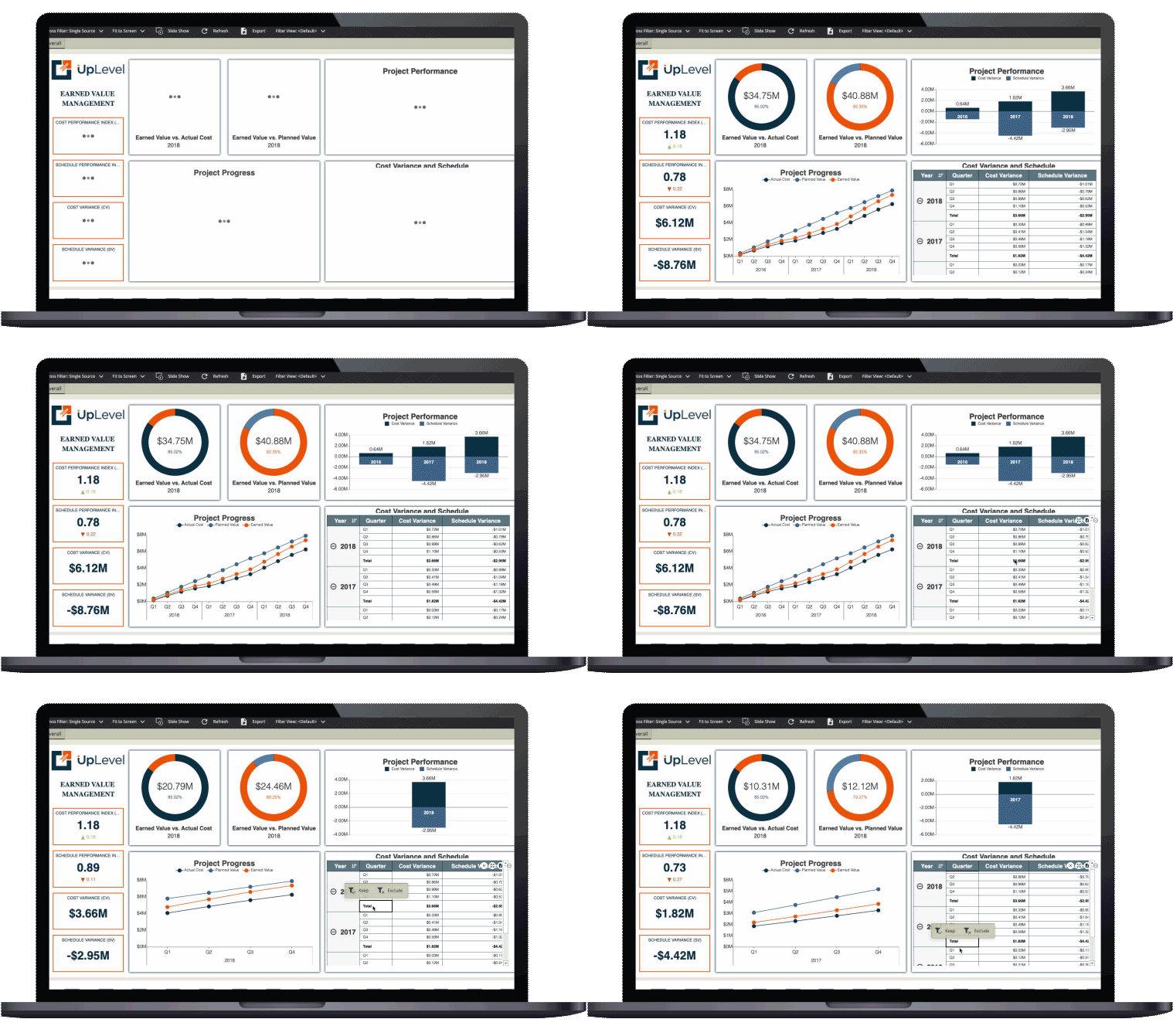
Embedded Business Intelligence Dashboard – Project Management
What to Look For in an Embedded BI Solution
Once you’ve decided to buy an embedded BI solution, you should carefully investigate its features. Organizations may have unique requirements, but they often need many of the same BI capabilities. Assess embedded BI requirements first to ensure you select the right embedded BI software for your goals.
For example, white-label self-service BI allows users to customize a third-party product to fit the look and feel of the solution it embeds into. Embedded BI should also include an application programming interface (API), which allows the business application to use custom hooks when embedding the BI capabilities.
Scalability is also a vital characteristic in a BI solution, especially for an enterprise. In particular, the scale of the solution’s operations must be able to increase quickly in response to an increase in its user base.
A third-party BI solution should also use a clear and straightforward licensing model, allowing organizations to quickly calculate the solution’s total cost of ownership (TCO). It’s also vital that the TCO not become cost-prohibitive as its operation scales up.
Users must also be able to use the embedded BI aspect within their business software without needing to log in a second time. Businesses should ensure that the third-party solution they select has security extensibility, meaning the solution can inherit the authorization and permissions needed to access it from the business application. For example, SaaS-based applications with multiple tenants should be able to secure resources at the data level.
For additional context, our article, 5 Things to Consider When Investing in a Business Intelligence Software, discusses compatibility, UI and UX, embeddability, white-labeling, and affordability.
FAQ: Embedded Business Intelligence
1. What is embedded business intelligence and how does it differ from traditional BI?
Embedded business intelligence (BI) integrates analytics, reporting, and visualization features directly into business applications, portals, or workflows. Unlike traditional BI, which requires users to switch to a standalone platform, embedded BI delivers real-time data insights within the tools users already use, increasing efficiency and adoption.
2. What are the main benefits of using embedded BI in business applications?
Embedded BI delivers analytics directly within core business applications, so users don’t need to switch between multiple tools. This integration drives faster decisions, higher adoption, and smoother workflows.
Key benefits include:
- Improved decision-making: Access insights at the moment of action.
- Higher user adoption: Users are more likely to engage with analytics when it’s part of their daily system.
- Cost savings: Reduce the need for separate, standalone BI platforms.
- Seamless user experience: Keep all data analysis within the same interface employees already use.
- Actionable insights: Act instantly on analytics without leaving workflows.
3. Which types of organizations benefit most from embedded BI solutions?
Embedded BI creates value across industries by bringing analytics directly into daily operations. It enables both employees and customers to make faster, data-driven decisions without leaving their core applications. Organizations that rely on real-time insights and self-service reporting are especially well-positioned to benefit.
Industries and organizations that gain the most include:
- SaaS providers: Offer clients built-in analytics and strengthen product value.
- Healthcare organizations: Improve patient care with real-time reporting and compliance tracking.
- Manufacturing companies: Optimize production, monitor OEE, and reduce downtime.
- Financial services: Enhance risk management, compliance, and performance analysis.
- Customer-focused businesses: Empower users with self-service dashboards inside everyday workflows.
4. What features should you look for in an embedded BI platform?
An effective embedded BI platform should balance power and ease of use. The right solution makes it simple for both technical and non-technical users to access insights, customize dashboards, and integrate analytics seamlessly into existing applications. Strong security and scalability ensure the platform grows with your business while maintaining governance.
Key features to look for include:
- Customizable dashboards: Tailor views to different roles and business needs.
- Interactive visualizations: Allow users to explore and drill down into data.
- Self-service reporting: Enable teams to create reports without IT support.
- Secure access control: Protect sensitive data with role-based permissions.
- Scalability: Support unlimited users and growing data volumes.
- Robust API integration: Connect smoothly with existing systems and workflows.
- White-labeling options: Brand the BI experience as part of your own application.
5. How does embedded BI improve user adoption compared to separate BI tools?
Because embedded BI is accessible within familiar applications, users are more likely to leverage analytics regularly. There’s no need to switch platforms, reducing training requirements and streamlining workflows. This integration leads to higher engagement and more widespread use of business intelligence insights.
6. Can embedded BI solutions support real-time analytics and reporting?
Yes, most modern embedded BI tools support real-time data connections. Users can access live dashboards, monitor key metrics, and receive instant alerts within their everyday applications, enabling agile responses to changing business conditions.
7. How is data security managed in embedded business intelligence?
Embedded BI platforms offer enterprise-grade security, including role-based access control, encryption, data masking, and compliance with industry standards. Security settings can be tailored to ensure sensitive information is protected while still enabling user access to relevant analytics.
8. What are best practices for implementing embedded BI successfully?
Start with clear business objectives and user requirements. Choose a scalable, flexible BI solution. Prioritize integration with existing systems, ensure user training and support, and continuously gather feedback for improvement. Involve stakeholders early to maximize adoption and long-term success.
9. What distinguishes Wyn Enterprise’s embedded BI from other solutions?
Wyn Enterprise offers a fully customizable, white-label embedded BI platform. Its unlimited user licensing, intuitive dashboard designer, seamless API integration, robust security, and support for real-time analytics make it a leading choice for enterprises seeking to empower users with in-app data insights.
10. Can embedded BI help software vendors and SaaS providers stand out?
Yes, embedded BI enables software vendors and SaaS companies to add value, differentiate their offerings, and retain customers. By delivering branded, in-app analytics and reporting, vendors empower users to make data-driven decisions, resulting in greater satisfaction and product stickiness.
Embed Turnkey Dashboards & Reports
Wyn is a 100% web-based embedded BI platform that provides greater insight into your data.
Wyn offers built-in tools for report and dashboard creation, multi-tendency, data governance, security integration, and automated document distribution. All with an easy-to-use interface for self-service BI.Get a Demo

Emmet McMahan
Emmet McMahan has been a full-time professional content writer for the past 13 years. Emmet specializes in technical topics, especially software development and health. He has a Bachelor of Science in Mathematics and Biology from Stephen F. Austin State University. When he is not writing, Emmet is an avid runner and has placed in several city-level 5K races.


Loved by industry
experts and real users